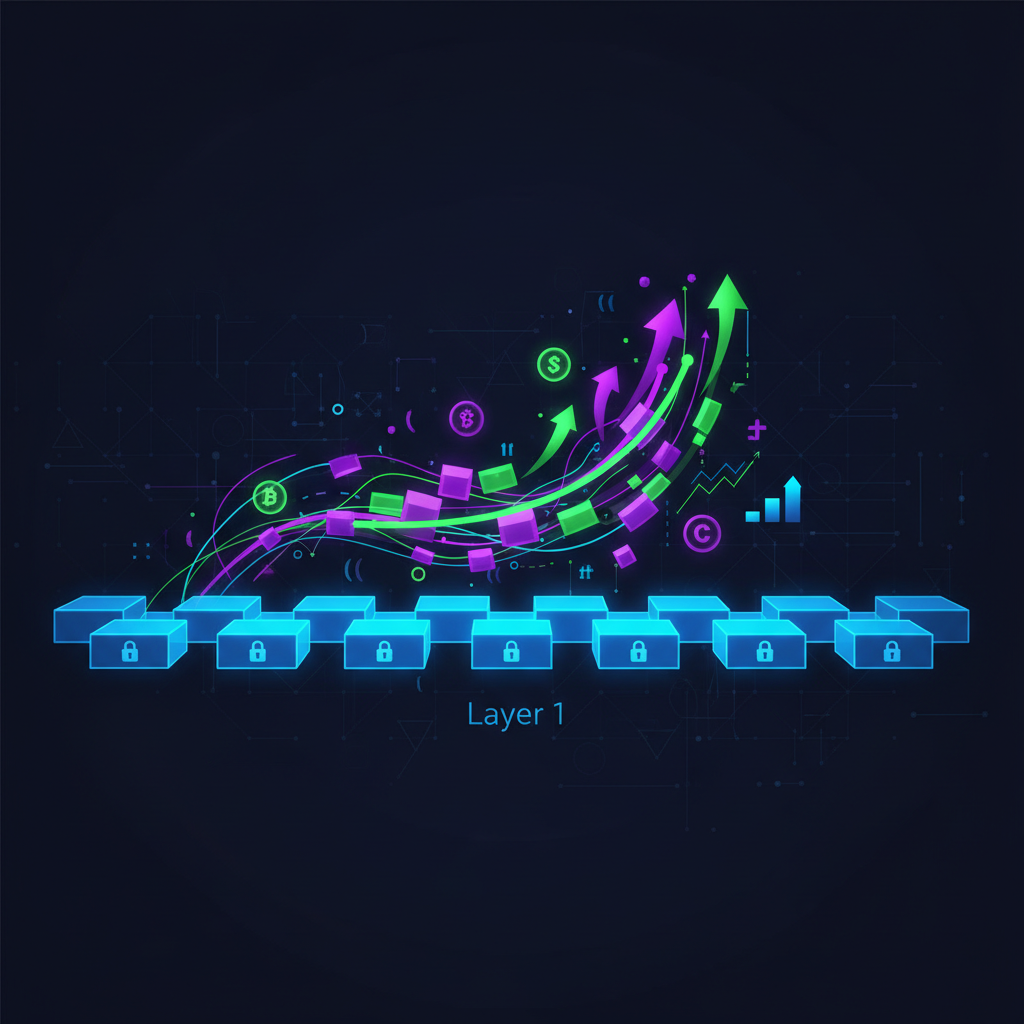
Basic concepts of blockchain scalability solutions
The solutions of layer 2 they are designed to improve the efficiency and speed of blockchains, processing transactions outside the main chain. This allows increasing capacity and reducing costs.
These solutions act on top of the blockchain layer 1, inheriting their security while easing congestion on the main network, facilitating higher transaction volume per second.
By working off-chain, layers 2 maintain decentralization and security, offering an effective response to the technical limits of traditional blockchains.
Definition and purpose of layer 2 solutions
Layer 2 solutions are technologies that work on a blockchain basis to speed up transaction processing. Its main purpose is to improve scalability without compromising security.
By executing operations outside the main chain, these solutions achieve greater speed and significantly reduce the commissions associated with transactions.
In addition, they allow the functionalities of the blockchain to be expanded, making it more flexible for the development of decentralized applications and advanced services.
Relationship between layer 1 and layer 2 in blockchain
Layer 1 represents the main blockchain, responsible for validating and securing each block. Layer 2 is built on top of it to optimize its performance without altering its base protocol.
Layer 2 solutions rely on Layer 1 security, ensuring that transactions processed off-chain are verifiable and reliable within the system.
This relationship allows for an effective combination: the robustness and security of layer 1 with the speed and efficiency of layer 2 to achieve a scalable and functional blockchain.
Main types of layer 2 solutions
The solutions of layer 2 they vary in technology and approach, but all seek to increase the efficiency of popular blockchains such as Bitcoin and Ethereum. These solutions allow you to handle more transactions without saturating the main chain.
Each type of solution has specific characteristics that optimize different aspects, from speed to cost reduction, adapting to the needs of each network and user.
Among the most notable are the Lightning Network for Bitcoin, rollups for Ethereum and other off-chain technologies that complement the capacity of current blockchains.
Lightning Network for Bitcoin
The Lightning Network it is a layer 2 solution created for Bitcoin that allows instant payments and almost no fees when operating outside the main chain. It works through two-way payment channels between users.
This network facilitates faster and cheaper transactions, enabling micropayments and improving the usability of Bitcoin for everyday uses.
When you close a channel, information is recorded on the main chain, ensuring that all off-chain transactions are backed up at layer 1.
Rollups for Ethereum
The rollups they are very popular solutions on Ethereum that group multiple transactions into a single test, processing them outside the main chain. This reduces the burden and costs on the base network.
There are two main types: Optimistic Rollups, which assume transactions are valid until proven otherwise, and ZK-Rollups, which use cryptographic validity tests for secure processing.
Rollups keep Ethereum secure by publishing data at layer 1, while significantly increasing speed and reducing fees.
Other off-chain technologies
Beyond Lightning and rollups, there are several off-chain technologies such as state channels and sidechains that also improve blockchain scalability.
State channels allow rapid exchanges between parties, while sidechains function as parallel chains that release the load of the main chain.
These solutions complement the Layer 2 ecosystem, offering different options to adapt to various use cases and decentralized applications.
Benefits of layer 2 scalability solutions
The solutions of layer 2 they significantly improve the speed and capacity of transactions, allowing greater volume to be processed without saturating the main network. This is key to mass use.
These technologies, by working off-chain, alleviate congestion at layer 1 by processing transactions faster, resulting in a smoother and more efficient user experience.
In addition, they increase the general scalability of blockchains, making it possible to develop more complex applications and manage greater data flows in real time.
Increase in speed and transaction capacity
Layer 2 solutions drive transaction processing capacity, reaching thousands per second, in the face of Layer 1 limitations. This enables effective scalability.
Processing transactions outside the main chain reduces confirmation time, improving speed and promoting the adoption of blockchain technology in everyday environments.
This speed combined with increased capacity is vital for financial applications, games and platforms that require immediate responses and high trading volume.
Reduction of transaction costs
By decreasing the load on the core network, Layer 2 solutions allow transaction fees to be considerably lower, facilitating micropayments and daily cryptocurrency usage.
This cost reduction incentivizes the frequent use of cryptocurrencies, making transactions accessible to a broader audience and not just large investors.
Furthermore, by optimizing gas spending and commissions, Layer 2 solutions increase economic efficiency in the blockchain ecosystem, favoring its long-term sustainability.
Impact on applications and adoption
The solutions of layer 2 they facilitate the development of complex applications and dApps by improving speed and reducing costs, enabling smoother and more versatile user experiences.
By increasing the capacity and efficiency of the base blockchain, these technologies open up new possibilities for decentralized financial services and other advanced use cases.
Facilitation of complex applications and dApps
Layers 2 provide an efficient environment for dApps to operate without congesting the core network, which is essential for the performance and scalability of complex applications.
Thanks to reduced fees and improved confirmation times, developers can create more sophisticated services, requiring high interactivity or frequent processing.
This drives innovation in sectors such as decentralized finance, gaming and digital markets, where user experience is key to mass adoption.
Contribution to the growth and adoption of cryptocurrencies
The improved efficiency of Layer 2 solutions makes cryptocurrencies more accessible and attractive to users and businesses, promoting their global adoption.
By reducing costs and increasing speed, these solutions allow cryptocurrencies to be used in daily transactions and massive services, overcoming previous barriers.
Thus, layers 2 are essential to scale the blockchain infrastructure and consolidate cryptocurrencies as payment methods and expanding technological platforms.