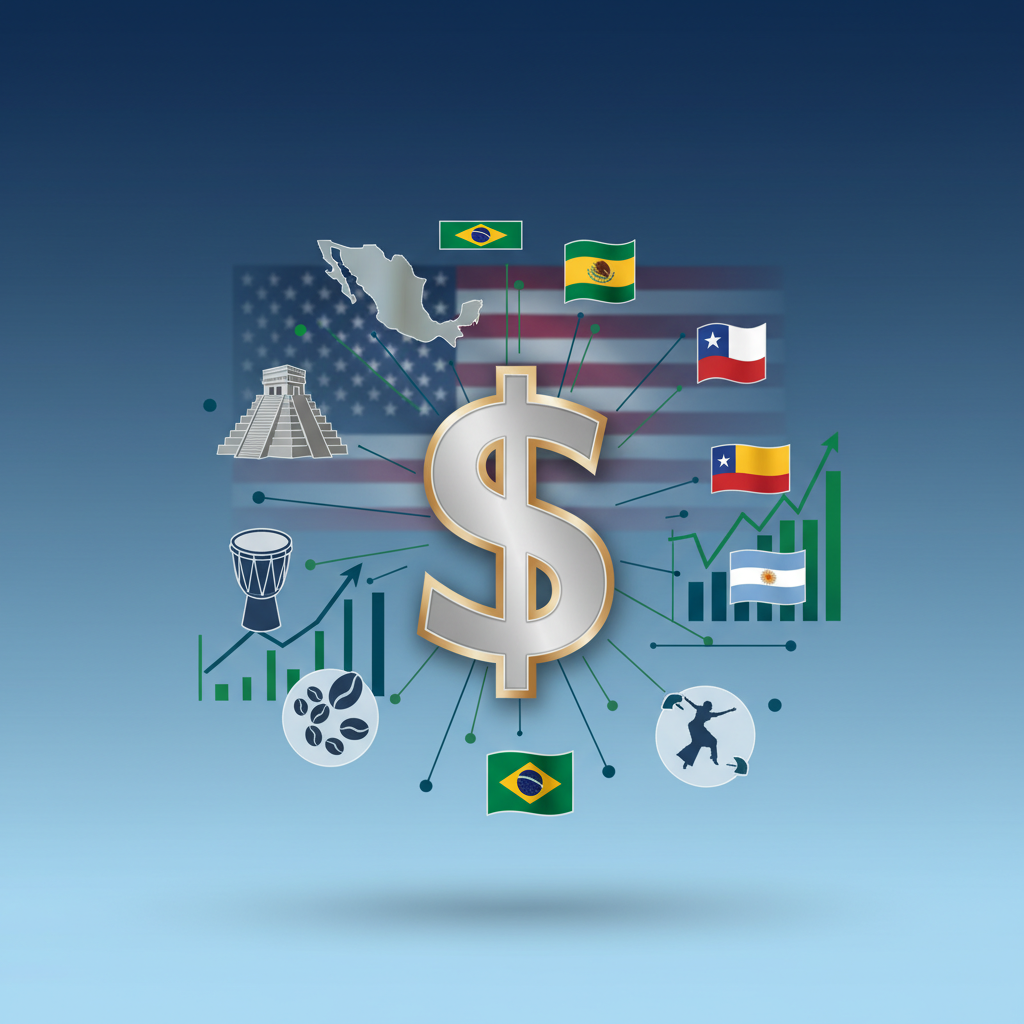
Influence of the dollar on debt and public spending
The US dollar plays a fundamental role in Latin American economies, being a reference currency for a large part of the external debt. A strong dollar increases payment costs for countries that have debt denominated in this currency.
This increase in debt payments generates pressure on public finances, limiting the government's spending capacity and increasing fiscal vulnerability. These dynamics affect economic and social stability in the short and medium term.
Effects of a strong dollar on foreign debt
When the dollar strengthens, the local currency value of the external debt increases considerably, raising the cost of its service. This forces greater resources to be allocated for payment, reducing availability for other priority expenses.
Furthermore, a strong dollar can increase the perception of credit risk, making access to new financing more expensive for Latin American countries. The depreciation of local currencies against the dollar aggravates this financial situation.
Impact on public spending and fiscal vulnerability
Public spending is usually adjusted based on the real cost of debt and other dollar commitments. Therefore, a strong dollar restricts social investments and projects through a greater fiscal effort to meet external obligations.
This increased burden can generate fiscal deficits, high levels of debt and greater pressure on monetary policy. Fiscal vulnerability is growing, limiting the state's ability to respond to economic or social crises.
Relationship between the dollar and inflation in Latin America
The dollar directly influences inflation in Latin America due to the strong dependence on imports and external debt in this currency. Fluctuations in the dollar affect the final prices of goods and services.
When local currencies depreciate against the dollar, the cost of imported products increases, which translates into the basic basket and generates inflationary pressures. This represents a challenge for regional economic stability.
Depreciation of local currencies and increase in the cost of imports
The depreciation against the dollar makes imports more expensive, since buying products in foreign currency requires more local weight. This mainly affects electronic products, fuels and basic foods.
This increase in imported prices is quickly reflected in the domestic market, raising the cost of living and especially affecting consumers with fixed incomes. Productive sectors also face higher input costs.
Consequences of inflation on the region's economies
Accelerated inflation reduces the purchasing power of the population and increases economic inequality. Countries face pressure to adjust monetary and fiscal policies, often with adverse effects on growth.
Furthermore, high inflation generates uncertainty, limits investment and causes wage adjustments that can produce inflationary spirals. Governments must seek balance to contain prices without slowing down the economy.
Variations in inflation according to the level of dollarization
Countries with greater financial and commercial dollarization usually experience lower inflationary impacts due to fluctuations in the dollar, since many transactions and prices are indexed to this currency.
In contrast, those with low dollarization are more vulnerable to inflation derived from exchange depreciation, since prices adjust upwards to compensate for the rise in the cost of imports and external debt.
Benefits of the dollar for exporters and economic stability
The US dollar represents a crucial advantage for raw material exporting countries, since their income is usually denominated in this currency. This allows greater stability and predictability in finances.
Furthermore, the use of the dollar contributes to maintaining economic stability, facilitating international trade and investment by reducing exchange risks and offering a clear reference for interest rates and prices.
Advantages for raw material exporting countries
Latin American countries that export natural resources benefit when the dollar is strong, as their income increases in terms of local currency. This improves its trade balance and international reserves.
This situation can also mitigate internal imbalances, given that a higher income in dollars strengthens public coffers and allows financing for development projects and social policies.
However, dependence on the dollar also poses risks if international prices fall, so economic diversification is key to reaping these benefits sustainably.
Influence of the dollar on exchange stability and interest rates
The dollar is a determining factor in the exchange stability of many Latin American countries, as it acts as a reference currency to establish monetary policies and control volatility.
Interest rates are also influenced by the dollar, since expectations about its strength condition investment and consumption decisions, directly affecting the domestic economy.
When the dollar remains stable, it facilitates debt management and economic planning, increasing market confidence and encouraging private and foreign investment.
Impact of volatility and recent fluctuations in the dollar
The volatility of the US dollar directly affects economic decisions in Latin America. Abrupt changes in its value generate uncertainty in fiscal and monetary policies.
This fluctuation makes government and business planning difficult, since exchange rate instability can alter costs, income and debts, affecting regional economic growth.
Effects of dollar volatility on economic policies
The volatility of the dollar forces Latin American governments to constantly adjust their fiscal and monetary policies to mitigate risks. This situation limits the ability to respond to economic crises.
In addition, international interest rates and reserves are affected, as central banks try to control inflation and stabilize the exchange rate against the volatility of the dollar.
The uncertainty generated can discourage foreign and private investment, since unexpected costs and exchange rate fluctuations complicate the evaluation of medium and long-term projects.
Consequences of the recent fall of the dollar in the region
The recent fall of the dollar has offered relief to several Latin American economies, reducing the cost of imports and easing pressure on public finances.
However, the impact is not uniform; Countries with high dependence on the dollar experience benefits, while others, with more dollarized economies, face mixed effects on stability and competitiveness.
This fall also generates expectations of lower inflation and exchange stability, favoring a more favorable environment for investment and domestic consumption in the region.