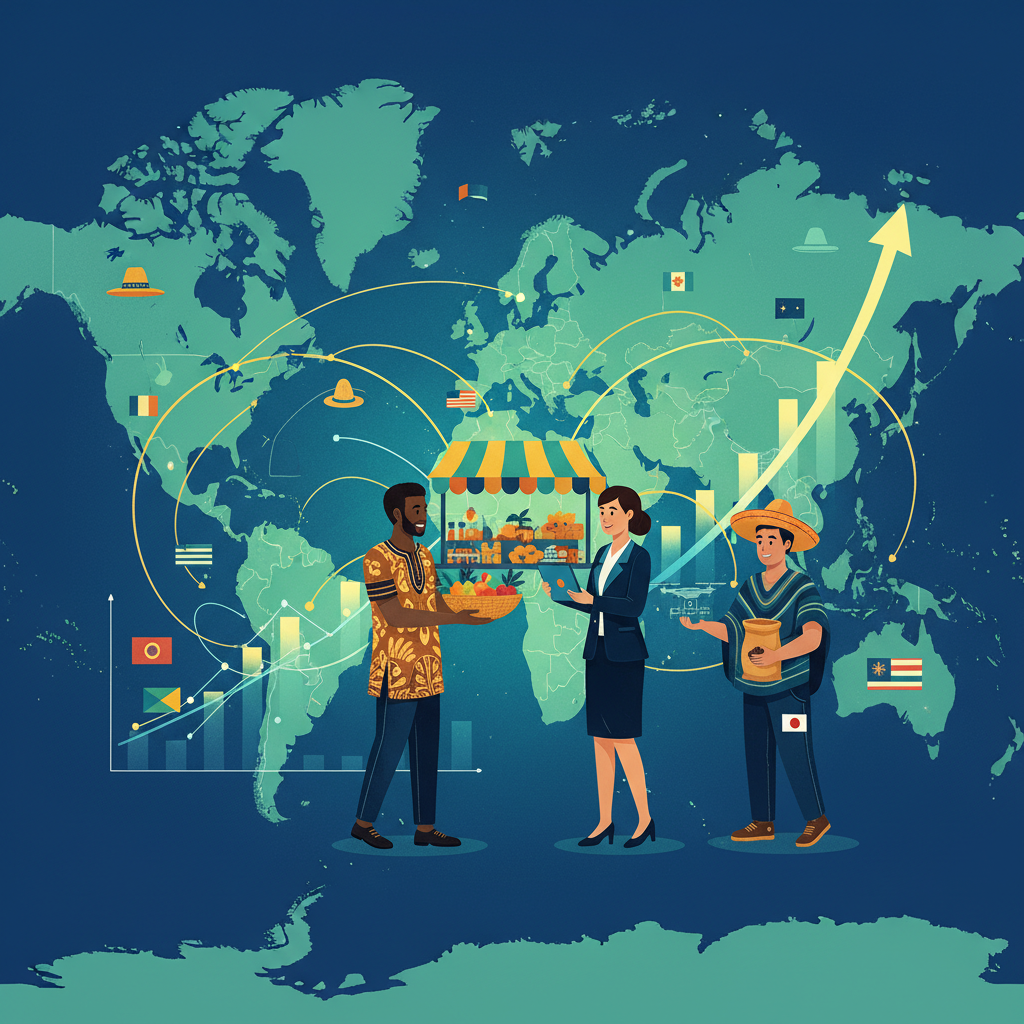
Economic impact of free trade agreements
Free trade agreements eliminate tariff barriers, allowing companies to access international markets more easily and at lower costs.
This greater openness encourages competition and reduces the prices of inputs and products, benefiting both consumers and local producers.
Access to markets and cost reduction
By eliminating tariffs, companies can export more and purchase inputs at lower prices, increasing their competitiveness in global markets.
This also means a greater variety of products for consumers and a reduction in overall production and sales costs.
It represents an opportunity for local regions to participate in international production chains, diversifying their sources of income.
Effects on employment and productive sectors
The agreements promote the creation of formal employment in export sectors, particularly benefiting areas integrated into global chains.
Examples like Peru show that cities with agroindustrial and textile industries have seen a significant increase in jobs.
Furthermore, growth in production and export stimulates innovation and specialization, strengthening the local economy and improving product quality.
Benefits of free trade for the local economy
Free trade drives key benefits by facilitating access to broader markets and fostering a competitive environment that strengthens the local economy.
Integration into global production chains promotes innovation and improves the conditions for the development and sustainable growth of local sectors.
These processes contribute to raising the quality of life through a greater offer of products at affordable prices, benefiting consumers and producers.
Promotion of competition and innovation
The competition generated by free trade encourages local companies to continually innovate and improve their products and processes.
This dynamic favors the adoption of new technologies, promoting productivity and competitiveness at the regional and national level.
As a result, local productive sectors are strengthened, capable of better responding to both internal and external demands.
Specialization and productive diversification
Free trade allows regions to specialize in activities where they have competitive advantages, optimizing resources and capabilities.
In addition, it favors productive diversification by opening opportunities in different sectors, reducing dependence on a single market.
This diversification contributes to local economic stability and the development of new industries with growth potential.
Improved well-being and access to products
By increasing the supply of goods and services, free trade allows consumers to access better quality products at lower prices.
This results in a general improvement in well-being, by increasing purchasing power and expanding the options available to families.
Furthermore, job creation in dynamic sectors favors higher incomes, positively impacting the local quality of life.
Challenges and challenges of free trade in local economies
Free trade presents significant challenges for local economies, especially in terms of inequality in the distribution of benefits.
It also generates impacts on environmental sustainability and can affect small local producers, who face new competition.
Unequal distribution of benefits and social equity
The benefits of free trade are not always distributed equitably between regions and productive sectors, generating inequalities.
More competitive areas tend to capture greater profits, while areas with lower capacities may lag behind.
This situation affects social equity, since not all population groups have equal access to the economic advantages of these treaties.
Therefore, it is essential to design policies that promote fair distribution to avoid deepening social gaps.
Impacts on sustainability and local producers
Increased trade can put pressure on natural resources, affecting environmental sustainability in some local regions.
Furthermore, competition with cheaper imports can harm less efficient local producers, threatening their viability.
This can lead to the loss of productive diversity and social effects linked to economic and environmental sustainability.
Relevant data
In some agricultural areas of Peru, the arrival of imported products generated the reduction of traditional crops, affecting biodiversity.
This phenomenon highlights the need to balance economic growth with the protection of the environment and local producers.
Strategies to maximize positive impact
To maximize the benefits of free trade, it is essential to design strategies that promote inclusion and mitigate inequalities between regions and sectors.
These strategies seek to balance economic growth with social and environmental sustainability, ensuring sustainable and equitable development.
Complementary policies to mitigate inequalities
It is necessary to implement public policies that support less competitive sectors and regions, facilitating their integration into global production chains.
Training programs, access to financing and infrastructure improvements are key tools to reduce the economic gaps generated by free trade.
These actions promote social equity, preventing the benefits of trade from being concentrated only in privileged groups or specific sectors.
Promotion of balanced and sustainable development
Promoting responsible business practices that protect the environment and use natural resources sustainably is essential.
Furthermore, the design of policies that encourage green innovation and investment in clean technologies contributes to economic growth with less environmental impact.
Balanced development must include the active participation of civil society and business to ensure that progress benefits the entire community.