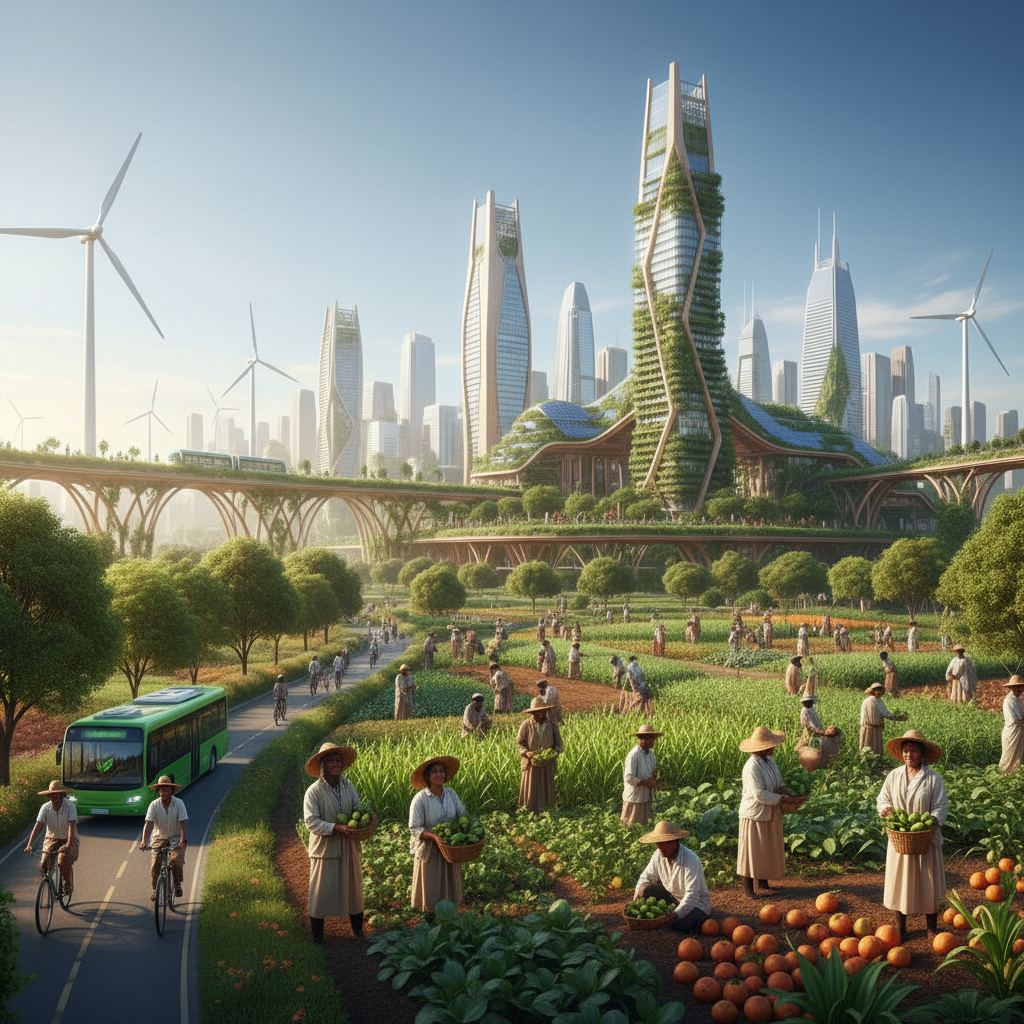
Advantages of the green economy for emerging countries
The green economy represents a crucial opportunity for emerging countries to achieve sustainable development by combining economic growth and environmental protection.
This transition contributes to poverty reduction and improves global competitiveness through innovative sectors that promote decent and sustainable jobs.
Generation of decent jobs in key sectors
The promotion of sectors such as renewable energies and sustainable agriculture creates decent jobs that strengthen the local economy and reduce social vulnerability.
These jobs not only improve family income, but also encourage training and specialization in environmentally friendly activities.
Furthermore, the formalization of green jobs contributes to guaranteeing labor rights and fair conditions for the workers involved.
Attraction of investments and international financing
The green economy attracts global investors interested in sustainable projects, generating a significant flow of capital to modernize key industries.
This financing allows the implementation of clean technologies, optimization of resources and development of infrastructure with less environmental impact.
Thus, emerging countries improve their position in international markets and promote the technological innovation necessary for green development.
Resource conservation and food security
The conservation of natural resources is vital to guarantee food security and the well-being of rural populations in emerging countries.
Sustainable management of water, soil and ecosystems promotes resilience to environmental threats and climate change.
Preservation of water, soil and ecosystems
The efficient and responsible use of water is essential to maintain healthy ecosystems and support sustainable agricultural production.
Soil conservation prevents its degradation and erosion, ensuring the fertility necessary for future crops and biodiversity.
Protecting ecosystems ensures key environmental services, such as pollination and climate regulation, that sustain agriculture and rural life.
Impact on the quality of rural life and agriculture
The green economy improves the quality of life in rural areas through agricultural practices that preserve natural resources and increase productivity.
Promotes sustainable techniques that reduce dependence on chemical inputs, reducing costs and improving the health of farmers.
Likewise, it promotes rural economic diversification, increasing resistance to market fluctuations and climate changes.
Poverty reduction and promotion of social inclusion
Social inclusion is key to combating poverty, guaranteeing access to green jobs and resources for vulnerable communities.
Programs based on the green economy strengthen local capacities, allowing marginalized groups to participate in sustainable productive activities.
This contributes to more equitable development and improving the socioeconomic conditions of traditionally excluded rural populations.
Challenges in the transition to a green economy
The transition to a green economy faces multiple challenges essentials that must be overcome to achieve sustainable and equitable development.
These challenges include the heavy dependence on traditional economic models and the lack of effective regulatory frameworks to encourage sustainable practices.
Dependence on traditional economic models
Many emerging countries depend on economies based on carbon-intensive industries, making rapid adoption of green models difficult.
This dependence limits investment in clean technologies and supports economic practices that negatively impact the environment and society.
Overcoming this situation requires transforming productive structures and promoting sectors with low environmental impact to promote real change.
Need for adequate regulatory frameworks
The lack of clear and adequate regulations slows down the development of the green economy by reducing incentives for responsible investments.
It is essential to establish public policies that promote the efficient use of resources and penalize polluting activities to ensure sustainability.
Furthermore, strong regulatory frameworks build trust and engage private and public actors to adopt eco-friendly practices.
Policies and strategies to promote the green economy
For the green economy to prosper in emerging countries, it is essential to implement public policies that promote a favorable and sustainable environment.
These strategies must focus on eliminating harmful practices and promoting innovation, consolidating a responsible and competitive economic model.
Elimination of harmful subsidies and promotion of incentives
Eliminating subsidies that favor fossil energy is crucial to reduce distortions and allow a real transition towards clean energy.
At the same time, encouraging companies and farmers to adopt green technologies facilitates the expansion of sustainable practices and improves competitiveness.
Tax and financial incentives aimed at green projects attract investments and strengthen the productive capacity of emerging sectors.
Thus, public policy promotes an economic model that favors environmental protection and equitable social development.
International collaboration and promotion of technological innovation
Cooperation between emerging and developed countries allows access to resources, knowledge and financing necessary for the green economy.
Technological exchange drives research and development to create solutions adapted to local and global challenges.
In addition, international alliances facilitate the transfer of clean technologies, accelerating productive modernization with less environmental impact.
Innovation in action
Multilateral organizations support projects that integrate renewable energy and resource efficiency, demonstrating the power of global collaboration.
These efforts help emerging countries lead the green agenda and strengthen their position in international sustainable markets.